When disaster strikes, house and contents insurance is often positioned as a safety net of modern Australian life. Yet many households are under-insured or not insured at all. In 2017, Kate Booth (UTAS), Bruce Tranter (UTAS), Shaun French (UoN), and I were awarded an Australian Research Council Discovery Project (DP170100096) to examine the social and cultural geographies of insurance in the context of wildfires, and to critically interrogate the ‘problem’ of underinsurance.
Summary of research findings
From 2017-2021, we carried out case study research in Tasmania, Victoria, and New South Wales, as well as a national survey. The findings from this research contribute to understandings of the role and power of insurers and insurance, how insurance and climate change can co-produce inequities and inequalities, and the action required to enable adaptive and just insurantial outcomes.
Underinsurance is the financial gap between the insurable and what is insured. It is calculable at scales ranging from nation states to households. Many assume that underinsurance calculations represent a singular reality and are infallible, if not indisputable. But contrary to common belief, we found that underinsurance is often not an outcome of poor consumer choices or a lack of affordability and availability; it is often not an issue of irrationality or market failure.
Instead, underinsurance is co-constituted through three scales: i) within the materiality of homelife, ii) within landscapes of risk and uncertainty, and iii) within the normative production of markets. All of these factors determine if, and how much, people choose to insure.
Underinsurance is often seen as a ‘problem in need of a solution’– the solution being insurance. Yet, as our research shows, underinsurance is inadequately accounted for as a singular ‘problem’. It exhibits bricolage qualities. It is also contestable – both as an idea and in practice.
In our writing, we present four avenues for addressing underinsurance:
- By contextualising rates of underinsurance through place;
- By improving integration of insurance within disaster management and planning processes;
- By dismantling hegemonic risk discourses; and
- By emphasising solidarity in the form and function of insurance in disaster preparedness and recovery. This, in turn, can contribute to more equitable and solidaristic understandings of, and responses to, underinsurance.
We conclude that tackling inequality and inequity is critical given the multifarious reasons why households are underinsured. Strategies for addressing disasters and global environmental change should be socially just and inclusive irrespective of whether households have insurance.
Summary of outputs
As we tally-up what we have achieved with this project, it is important to emphasise our gratitude to the householders, communities, practitioners, other academics, and the Australian Research Council who contributed in diverse and impactful ways to this research. Thank you!
Our achievements range from the academic, such as an open access edited book, a long list of journal articles (two of which are award-winning), contributions to public conversations via conferences and media interviews, and the ability to employ talented researchers (Eliza de Vet, Chloe Lucas, Scott McKinnon, and Travis Young), to the privilege of working with at-risk communities and disaster survivors who have shared generously of their time and personal experiences.
The following lists our written achievements by type and in chronological order. Please contact us if you would like access to particular articles that are not freely available.
The Conversation articles
Booth, K., Tranter, B., & Eriksen, C. (2015) Properties under fire: Why so many Australians are inadequately insured against disaster, The Conversation.
Lucas, C., Eriksen, C., & Bowman, D. (2020) A crisis of underinsurance threatens to scar rural Australia permanently. The Conversation.
Booth, K., Lucas, C., & Eriksen, C. (2021) Underinsurance is entrenching poverty as the vulnerable are hit hardest by disasters. The Conversation.
Peer reviewed journal articles
Booth, K. (2018) Profiteering from disaster: Why planners need to be paying more attention to insurance. Planning Practice and Research 33(2): 211-227.
Booth, K. & Tranter, B. (2018) When disaster strikes: Under-insurance in Australian households. Urban Studies 55(14): 3135-3150.
de Vet, E., Eriksen, C., Booth, K. & French, S. (2019) An unmitigated disaster: Shifting from response and recovery to mitigation for an insurable future. International Journal of Disaster Risk Science 10: 179-192.
Tranter, B. & Booth, K. (2019) Geographies of trust: Socio-spatial variegations of trust in insurance. Geoforum 107: 199-206.
de Vet, E. & Eriksen, C. (2020) When insurance and goodwill are not enough: Bushfire Attack Level (BAL) ratings, risk calculations and disaster resilience in Australia. Australian Geographer 51(1): 35-51.
Winner of the Geographical Research Wiley Prize 2021
Institute of Australian Geographers and Wiley Publishers
Eriksen, C. & de Vet, E. (2020) Untangling insurance, rebuilding, and wellbeing in bushfire recovery. Geographical Research 59(2): 228-241.
Winner of the 2020 Dorothy R Taylor Award for Best Paper published in the Australian Geographer
The Geographical Society of New South Wales
Eriksen, C., McKinnon, S. & de Vet, E. (2020) Why insurance matters: Insights from research post-disaster. Australian Journal of Emergency Management 35(4): 42-47.
Lucas, C. & Booth, K. (2020) Privatizing climate adaptation: How insurance weakens solidaristic and collective disaster recovery. WIREs Climate Change 11(6): e676.
Booth, K. & Kendal, D. (2020) Underinsurance as adaptation: Household agency in places of marketization and financialization. Environment and Planning A: Economy and Space 52(4): 728-746.
Booth, K. (2021) Firescapes of disruption: An absence of insurance in landscapes of fire. Environment and Planning E: Nature and Space 4(2): 525-544.
Booth, K. (2021) Critical insurance studies: Some geographic directions. Progress in Human Geography 45(5): 1295-1310.
de Vet, E., Eriksen, C. & McKinnon, S. (2021) Dilemmas, decision-making, and disasters: Emotions of parenting, safety, and rebuilding in bushfire recovery. Area 53(2): 283-291.
Lucas, C., Booth, K. & Garcia, C. (2021) Insuring homes against extreme weather events: A systematic review of the research. Climatic Change 165(3): Article 61.
Young, T., Lucas, C. & Booth, K. (2022) Insurance, fire and the peri-urban: Perceptions of changing communities in Melbourne’s rural-urban interface. Australian Geographer 53(1): 41-60.
Booth, K., Lucas, C., Eriksen, C., de Vet, E., Tranter, B., French, S., Young, T. & McKinnon, S. (2022) House and contents underinsurance: Insights from bushfire prone Australia. International Journal of Disaster Risk Reduction 80(1): 103209.
Booth, K., Davison, A., & Hulse, K. (2022) Insurantial imaginaries: Some implications for home-owning democracies. Geoforum, 136, 46-53.
Edited book and book chapters
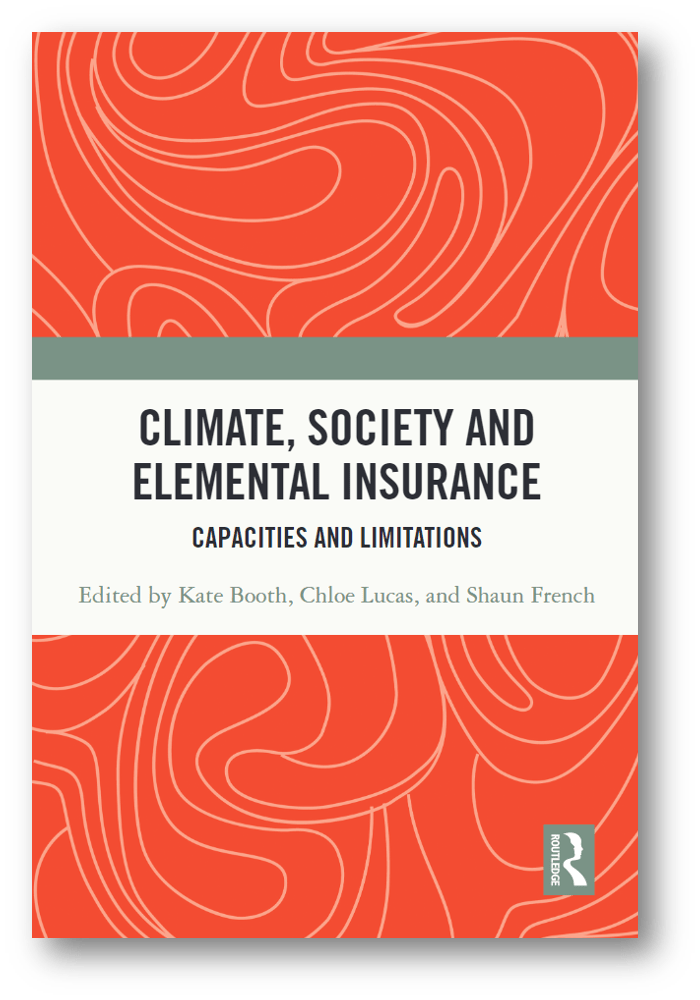
Booth, K., Lucas, C., & French, S. (2022) Climate, Society and Elemental Insurance: Capacities and Limitations. Routledge: Oxford, UK.
Booth, K. (2022) ‘Introduction’. In: Booth, K., Lucas, C. & French, S. (Eds), Climate, Society and Elemental Insurance: Capacities and Limitations. Routledge: Oxford, UK, Chp.1, pp.1-7.
Lucas, C. & Young, T. (2022) ‘After the flood: Diverse discourses of resilience in the United States and Australia‘. In Booth, K., Lucas, C. & French, S (Eds), Society and Elemental Insurance: Capacities and Limitations. Routledge: Oxford, UK, Chp.6, pp.70-82
McKinnon, S., Eriksen, C., & de Vet, E. (2022) ‘Between presence and absence: Questioning the value of insurance for bushfire recovery’. In: Booth, K., Lucas, C. & French, S (Eds), Climate, Society and Elemental Insurance: Capacities and Limitations. Routledge: Oxford, UK, Chp.8, pp.99-110.
Lucas, C. (2022) ‘Conclusion: Deconstructing the dualisms of elemental insurance‘. In: Booth, K., Lucas, C. & French, S. (Eds), Climate, Society and Elemental Insurance: Capacities and Limitations. Routledge: Oxford, UK, Chp.16, pp.219-224.
 Dr. Christine Eriksen
Leave a comment