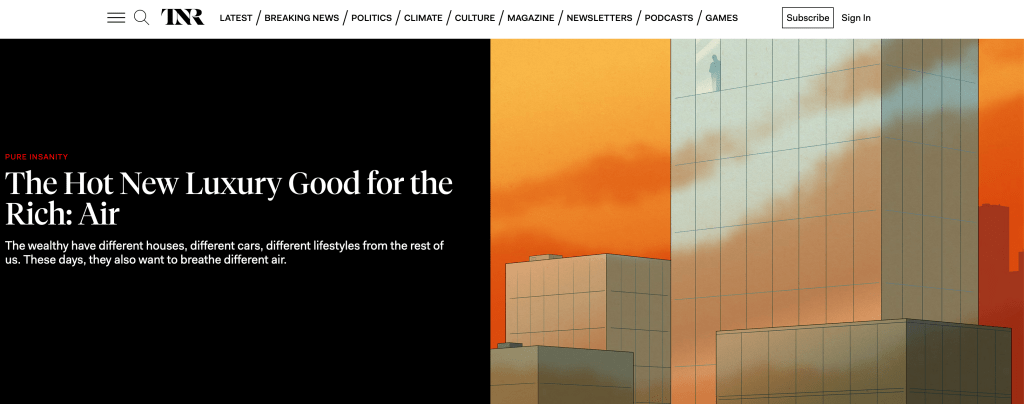
As weeks or months of chronic smoke conditions caused by wildfires impede “business as usual”, the quest to secure clean air has – in and of itself – become a business. Late last year, science journalist Shayla Love interviewed me for an article in The New Republic about The Hot New Luxury Good for the Rich: Air. We discussed the varied ways inequity is perpetuated when clean air is treated as a commodity, as well as the immense potential technological innovation holds if it drives social betterment, not just luxury goods.
Smoke from wildfires doesn’t care about neighborhoods or country borders. Primarily made up of fine particulate matter less than 2.5 microns long, it is mobile, and small enough to intrude nearly anywhere – high-rises and homes, airways and lungs. Drifting smoke has made the consequences of catastrophic wildfires a reality far from the fire front. More than just an inconvenience to everyday life, it also poses significant potential danger to human health.
This is a reality already experienced with an alarming frequency in North America and Australia in recent summers. It is also likely to be the first direct experience many Europeans have with wildfire, as the continent as a whole becomes more fire-prone. Smoke from wildfires, like sand from the Saharan desert, will likely travel and choke the skies in low-lying cities in Switzerland long before actual flames become a regular occurrence in the country.
My colleague Gregory Simon and I also wrote about the unequal social consequences of wildfire smoke for Bay Nature in 2021 after a season of chronic smoke conditions in California.
 Dr. Christine Eriksen