Books & Book Chapters
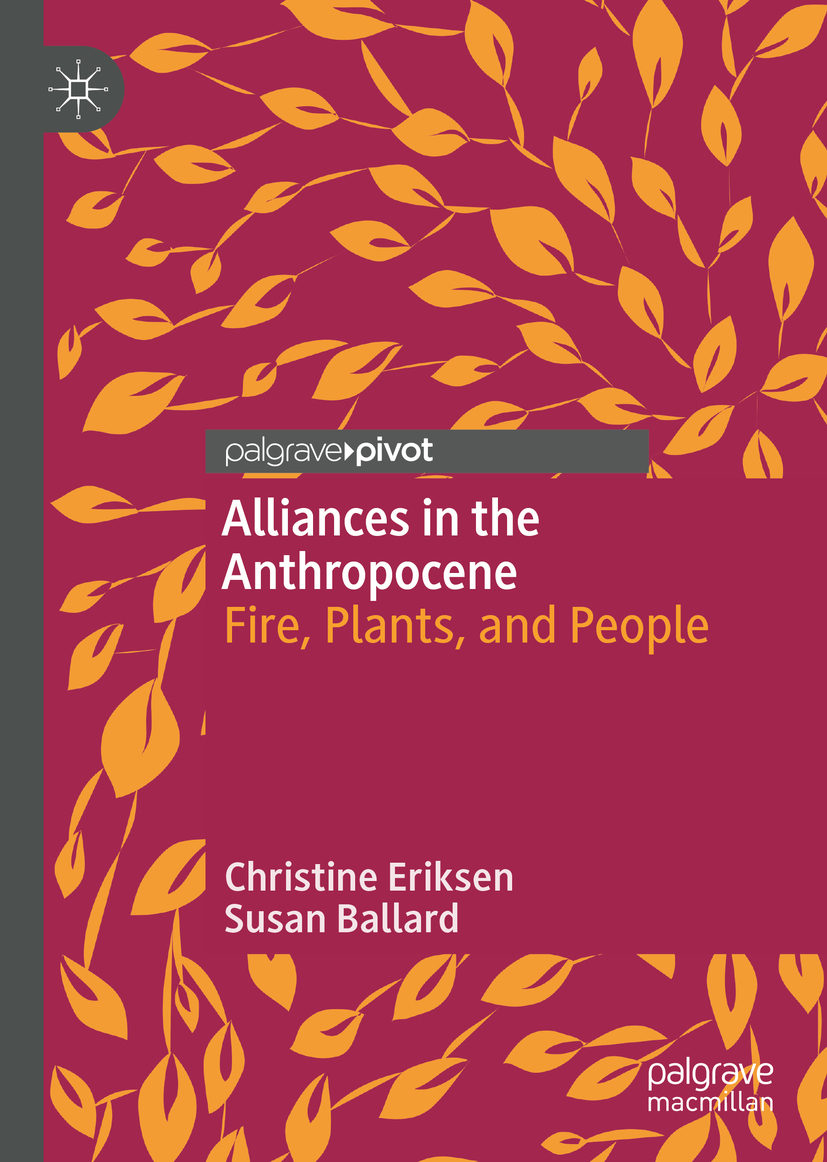

Alliances in the Anthropocene: Fire, Plants and People
by Christine Eriksen and Susan Ballard
Published in 2020 by Palgrave Macmillan
Alliances in the Anthropocene examines how human impacts on the planetary system are being felt at all levels, from the geological and the arboreal to the atmospheric. Christine Eriksen and Susan Ballard examine the agency of fire, plants and people within a changing climate. They embrace the narratives of bushfire survivors and responses of contemporary artists, as practice and experience become interwoven with fire, ruin and regrowth. From Aboriginal ecocultural burning and wildfire to nuclear fire, the authors show how relationships come to be and are likely to change due to human and non-human interdependencies in the Anthropocene.
The authors’ gripping stories about fire, plants and people in Australia have global relevance. They demonstrate the folly of thinking we can or should seek to domesticate and control the forces of life on our remarkable planet.
Prof Noel Castree, University of Manchester, UK, 2020
Christine Eriksen and Susan Ballard’s book is an important and accessible conduit into thinking about human (mal)adaptation to bushfire. … it sets up the problem of how thinking-beings should think and act when there is evidence that the world that they know is ending.
Prof David Bowman, University of Tasmania, Australia, 2021
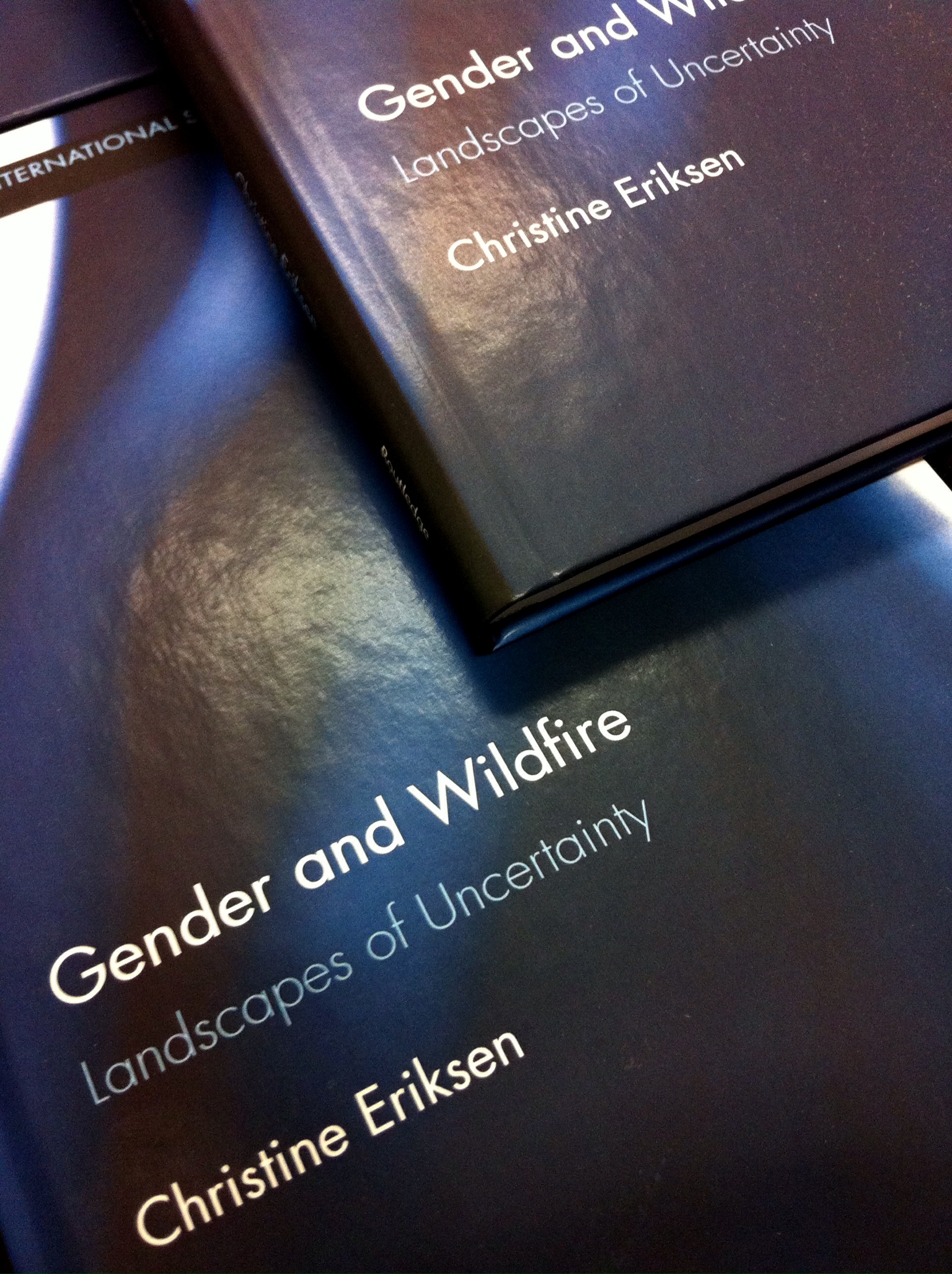
Gender and Wildfire: Landscapes of Uncertainty
by Christine Eriksen
Published in 2014 by Routledge
In pursuit of lifestyle change, affordable property, and proximity to nature, people from all walks of life are moving to the wildland-urban interface. Tragic wildfires and a predicted increase in high fire danger weather with climate change have triggered concern for the safety of such amenity-led migrants in wildfire-prone landscapes. This book examines wildfire awareness and preparedness amongst women, men, households, communities and agencies at the interface between city and beyond. It does so through an examination of two regions where wildfires are common and disastrous, and where how to deal with them is a major political issue: southeast Australia and the west coast United States. It follows women’s and men’s stories of surviving, fighting, evacuating, living and working with wildfire to reveal the intimate inner workings of wildfire response – and especially the culturally and historically distinct gender relations that underpin wildfire resilience. Wildfire is revealed as much more than a “natural” hazard – it is far from gender-neutral. Rather, wildfire is an important means through which traditional gender roles and power relations are maintained despite changing social circumstances. Women’s and men’s subjectivities are shaped by varying senses of inclusion, exclusion, engagement and disengagement with wildfire management. This leads to the reproduction of gender identities with clear ramifications for if, how and to what extent women and men prepare for wildfire.
Dr Eriksen does not avoid subjects considered taboo but addresses them with brutal honesty and sympathy … a very important read.
Prof Maureen Reed, University of Saskatchewan, Canada, 2014
Book Chapters
Eriksen, C. (2023) Fire. In N. Wallenhorst and C. Wulf (Eds.), Handbook of the Anthropocene, pp.133–137. Springer, Cham.
Eriksen, C. & Herzog, S. (2023) Nuclear Waste. In N. Wallenhorst and C. Wulf (Eds.), Handbook of the Anthropocene, pp.1521–1525. Springer, Cham.
Reimer, R. & Eriksen, C. (2022) Leadership in Mountain and Wildland Professions in Canada: Examining the impacts of gender, safety, and climate change. In A. Fletcher & M. Reed (Eds.), Gender and the Social Dimensions of Climate Change: Rural and Resource Contexts of the Global North, Chapter 6, pp. 149-167. New York: Routledge.
Lakhina, S. J. & Eriksen, C. (2022) Seeking Safe Refuge in Regional Australia: Experiences of hazards and practices of safety among women from refugee backgrounds. In A. Fletcher & M. Reed (Eds.), Gender and the Social Dimensions of Climate Change: Rural and Resource Contexts of the Global North, Chapter 2, pp. 38-54. New York: Routledge.
Eriksen, C. & Turnbull, J. (2022) Insure the Volume? Sensing air, atmospheres and radiation in the Chornobyl Exclusion Zone. In Booth, Lucas & French (Eds.), Climate, Society and Elemental Insurance: Capacities and Limitations. New York: Routledge.
McKinnon, S., Eriksen, C. & de Vet, E. (2022) Between Absence and Presence: Questioning the value of insurance for bushfire recovery. In Booth, Lucas & French (Eds.), Climate, Society and Elemental Insurance: Capacities and Limitations. New York: Routledge.
Dominey-Howes, D., McKinnon, S., Gorman-Murray, A. & Eriksen, C. (2022) Sexual and Gender Minorities in Disasters. In T. McGree, T. & E. Penning-Rowsell (Eds.) Handbook of Environmental Hazards and Society, New York: Routledge.
Towers, B., Christianson, A. & Eriksen, C. (2019) Impacts of Wildfire on Children. In Encyclopedia of Wildfires and Wildland-Urban Interface (WUI) Fires, eds. S. Manzello. Cham: Springer.
McGee, T. & Eriksen, C. (2018) Defensive Actions and People Preparedness. In Encyclopedia of Wildfires and Wildland-Urban Interface (WUI) Fires, eds. S. Manzello. Cham: Springer.
Eriksen, C. & Waitt, G. (2016) Men, Masculinities and Wildfire: Embodied Resistance and Rupture. In Men, Masculinities and Disaster, eds. E. Enarson and B. Pease. Chapter 6, 69-80. New York: Routledge.
Eriksen, C. & Hankins, D. (2015) Colonisation and Fire: Gendered Dimensions of Indigenous Fire Knowledge Retention and Revival. In The Routledge Handbook of Gender and Development, eds. A. Coles, L. Gray & J. Momsen. Chapter 14, 129-137. New York: Routledge.
Prior, T. & Eriksen, C. (2012) What does being “well-prepared” for bushfire mean? In Wildfire and Community: Facilitating preparedness and resilience, eds. D. Paton & F. Tedim. Chapter 10. Springfield, Ill.: Charles C. Thomas Publisher.
Eriksen, C. & Adams, M. (2010) Indigenous Environmental Knowledge. In Encyclopaedia of Geography, eds. B. Warf. 1564-1567. Sage Publications.
 Dr. Christine Eriksen