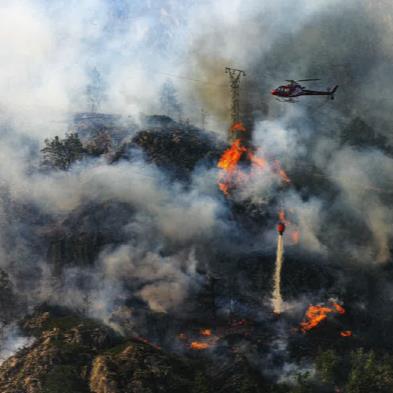
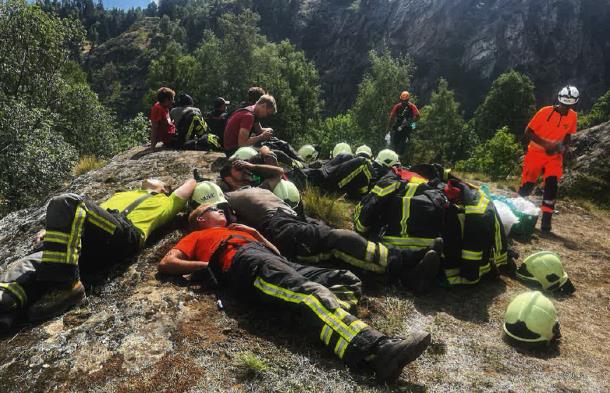

(Photos are from the photo-book “Brand am Riederhorn” (2023), reproduced with the kind permission of the Bitsch and Riederhorn Municipalities.)
For the past year, Lena Widmer has focused her Masters project on the 2023 Riederhorn wildfire in Canton Valais, Switzerland. Commonly referred to in the press as the Bitsch wildfire, the Riederhorn more accurately refers to the mountain on which the wildfire burnt, causing evacuations and distress among the impacted municipalities of Bitsch and Riederalp.
The Canton of Valais has a history of disastrous avalanches, landslides, debris flows, floods and increasingly also wildfires. The Riederhorn wildfire is the third wildfire since 2000 that has threatened communities. In 2003, a wildfire in Leuk damaged 300 ha of forest, including 70 ha of protective forest, as well as a small chalet and a vineyard cottage. In 2011, a wildfire in Visp damaged 110 ha of protective forest. The Riederhorn wildfire started on 17 July 2023 and spread rapidly due to dry conditions and strong winds. It led to the evacuation of circa 200 residents from Oberried and Ried-Mörel. Hundreds of firefighters from Valais and other cantons, as well as members of the civil protection services were deployed. It took more than three weeks to fully extinguish the wildfire due to the challenging mountainous terrain and weather conditions. The wildfire damaged about 185 ha of protective forest, which increases the risk of subsequent gravitational hazards.
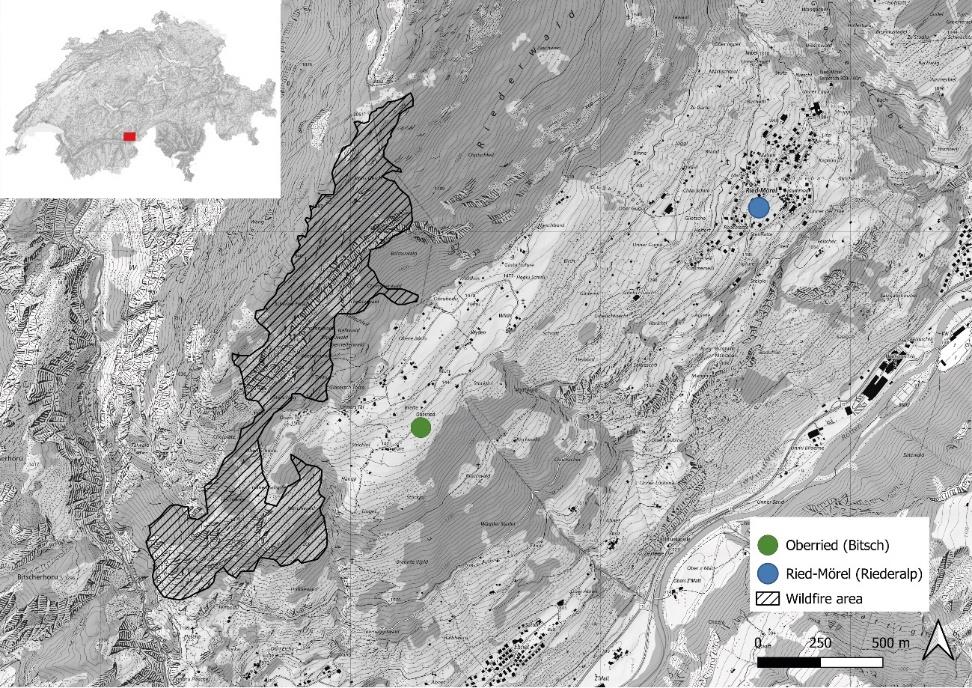
(Topographic map indicating the burnt area and location of evacuated villages. Created by L. Widmer with data from Swisstopo (2025).)
Lena’s research provides a case study of a Swiss mountain community directly impacted by wildfire. Using narrative interviews conducted with local residents and professionals managing the event, Lena’s Masters thesis explores people’s experiences and understandings of risk, with special attention to solidarity, community cohesion, agency, and the everyday.
Overall, the case study of the Riederhorn wildfire shows that complex emotional, physical, and logistical challenges affected both residents and professionals who managed the event. Participants recalled initial sensory and emotional responses in detail. They displayed a wide range of emotions that left a lasting emotional and embodied memory. Throughout the interviews, professionals tended to use more technical terms in their narratives, but they also reported physical and mental exhaustion. The case study highlights the emergence of community cohesion and spontaneous self-organisation, where people stepped into informal support roles that complemented official emergency responses, showing solidarity and agency. With such grassroots-effort by residents and volunteers, a sense of collective action emerged, strengthening a bottom-up risk culture. The wildfire disrupted daily routines, with its impact varying depending on geographical proximity, social roles, or prior experience with hazards.
Furthermore, when examining understandings of risk, the wildfire was found to have led to increased awareness. In some cases, the experience led to increased vigilance. However, professionals noted a perceived tendency for this heightened awareness to fade once the immediate danger passed. Perceptions of risk differed, with professionals focusing on longer-term patterns and structural prevention, while some participants, both professional and residential, expressed a sense of resignation toward human-caused fires. Despite these challenges, most participants do not live in fear. Instead, they showed a pragmatic perspective, viewing natural hazards as an inherent part of life in mountainous Valais. This perspective was reinforced by a high level of trust in emergency systems and community cohesion. The perception of a recurring ten-year cycle of wildfires in Valais further contributes to a sense of both inevitability and readiness to respond.
The recommendations derived from Lena’s Masters research have practical, theoretical and policy implications. First, practical implications include the acknowledgement of grassroots-solidarity and spontaneous volunteerism. While community members provided essential support, such engagement can also challenge emergency services that operate within hierarchical, command-and-control structures. Rather than treating it either as a benefit or as a problem, Lena’s thesis proposes that Swiss wildfire governance should proactively integrate community agency into professional emergency responses. Collaborative and participatory wildfire management and governance processes could, for example, include wildfire-specialised training for volunteers or community crisis management teams. In addition, the strong emotional and embodied dimensions of the wildfire experience show the need for psychosocial support that goes beyond the acute emergency phase and includes both residents and professionals. The pragmatic approach to wildfire risk that was found in the case of the Riederhorn wildfire highlights the benefits of an effective communication strategy that takes different understandings of risk, embodied memory, and local traditions – such as the use of irrigation sprinkler systems – into account. Existing volunteers could be more involved in raising awareness among the broader population.
Second, when looking at the theoretical contributions, Lena’s findings extend scholarly debates on geographies of disasters by showing how even in a Swiss context with high levels of trust in institutions and emergency systems, wildfire experiences are shaped by emotions, sensory impressions, and community cohesion. This highlights the need for more research on emotional labour in Swiss-specific and broader European wildfire contexts.
Third, Lena’s results show that risk perception is not only influenced by single experiences and personal awareness but also by trust and collective memory. A consequent policy implication could be the integration of participatory wildfire governance models to better involve residents and volunteers in opportunities for preparation and response. Planning for climate adaptation and wildfire response should not only include technical and infrastructural considerations but also take psychological and emotional aspects into account. In Switzerland, some cantons have more experience in wildfire management than others. It is therefore important that insights and experiences are shared across cantonal borders and with neighbouring countries. International examples also demonstrate how participatory strategies can be institutionalised in practice to empower communities. Initiatives in North America, such as FireSmart Canada and Firewise USA, emphasise local preparedness and shared responsibility. Non-profit initiatives, such as the Pau Costa Foundation in Catalonia highlight collaborative landscape-level strategies, and the long history of community bushfire preparedness in Australia show how even children can be included in awareness and preparedness activities.
These examples illustrate possible pathways for Switzerland to adapt. Evidence from fire-prone regions internationally demonstrate that well-informed communities are more resilient in the face of disasters, and when emergency services work collaboratively to build that preparedness, their own resources are less strained during emergencies. It makes communication pathways more efficient and response actions easier to implement.

It has been a real pleasure supervising Lena’s Masters research.
Please join me in congratulating Lena on an excellently executed Masters project!
Lena’s thesis will shortly be available to download via the University of Bern’s library or the Institute of Geography.

