Published: 3 November 2026. Text: Victoria Preining
Waldbrände: Müssen wir mit dem Feuer leben lernen? Welt der Frauen
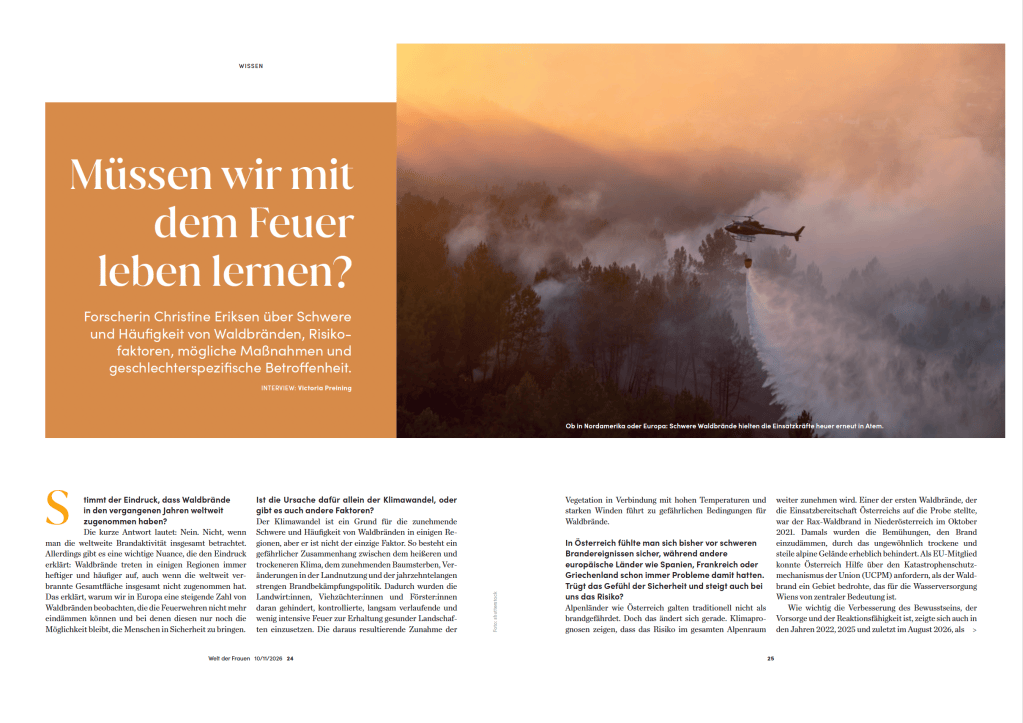
Whether in North America or Europe, severe wildfires have once again kept emergency services on their toes this year. Researcher Christine Eriksen on the severity and frequency of wildfires, risk factors, possible measures and gender-specific impacts.
Is the impression correct that wildfires have increased worldwide in recent years?
Eriksen: The short answer is: no. Not if you look at global fire activity as a whole. However, there is an important nuance that explains this impression: wildfires are becoming increasingly severe and frequent in some regions, even though the total area burnt worldwide has not increased overall. This explains why, in Europe, we are seeing a rising number of wildfires that the fire services can no longer contain, leaving them with no option but to evacuate people to safety.
Is climate change the sole cause of this, or are there other factors too?
Climate change is one reason for the increasing severity and frequency of wildfires in some regions, but it is not the only factor. There is a dangerous interplay between the hotter and drier climate, increasing tree mortality, changes in land use and decades of strict fire suppression policies. This has prevented farmers, livestock breeders and foresters from using controlled, slow-burning and low-intensity fires to maintain healthy landscapes. The resulting increase in vegetation, combined with high temperatures and strong winds, creates dangerous conditions for wildfires.
In Austria, people have so far felt safe from severe wildfires, whilst other European countries such as Spain, France and Greece have always struggled with them. Is this sense of security misleading, and is the risk rising here too?
Alpine countries such as Austria were traditionally not considered to be at risk of wildfires. However, this is currently changing. Climate forecasts indicate that the risk will continue to rise across the entire Alpine region. One of the first wildfires to put Austria’s emergency response capabilities to the test was the Rax wildfire in Lower Austria in October 2021. At the time, efforts to contain the fire were significantly hampered by the unusually dry and steep alpine terrain. As an EU member state, Austria was able to request assistance via the Union Civil Protection Mechanism (UCPM) when the wildfire threatened an area of vital importance to Vienna’s water supply. The importance of improving awareness, preparedness and response capacity was also highlighted in 2022, 2025 and, most recently, in August 2026, when fires once again devastated large areas of forest. As a result, the new national action plan ‘Brennpunkt Wald’ was published in Austria as early as 2022.
Before your work in Switzerland, you conducted research and worked in the field of prevention in Australia, amongst other places. What differences have you observed between the two regions? What can we learn from Australians?
Australia has spent decades building resilience to wildfires at a community level. People living in fire-prone areas are actively encouraged to understand the risk and mitigate it through precautionary measures. In Europe, by contrast, a top-down approach is still pursued: the authorities attempt to manage the risk and dictate to people what they must do in an emergency. In Australia, much greater emphasis is placed on the exchange of knowledge and shared responsibility between authorities and local communities. This puts people in a better position to make informed decisions about risk management, preparing for wildfires and safety in an emergency.
How can we prevent severe wildfires in future? Or must we accept that such events could become a regular occurrence?
First of all: I found the media coverage of the wildfires in Europe this summer frustrating. Reports focused primarily on aerial firefighting, theories about the causes of climate change and finger-pointing. There was a lack of holistic insights into cause and effect, as well as possible solutions. The climate cannot be changed in the short term. But we can and must manage the land and its fuel load. We must work with local communities to help them prepare better. All the pieces of the puzzle for resilience are in place. We need policy measures to fund the necessary work. It is also important to understand that not all fires are harmful. Many indigenous communities distinguish between ‘good fire’ and ‘bad fire’. Good fire helps to maintain healthy ecosystems. Bad fire refers to the catastrophic wildfires we are experiencing today. Living with fire means understanding its role in the landscape and learning to manage it intelligently.
What would you like to see from European countries in terms of their approach to wildfires?
I would like to see local communities recognised and involved in building resilience to wildfires. There are three key factors for successful engagement: practical experience and exercises, strong local networks, and supportive learning environments. Incorporating local knowledge and collaborating with people of all genders and age groups boosts the community’s resilience. The better prepared people are and the more independently they act, the more willing they are to communicate and take responsibility. This means they are less reliant on the limited resources of the emergency services, and are better able to understand and act on official warnings.
Speaking of community: you have not only conducted research into the causes and prevention of wildfires, but also in the area of ‘Gender and Wildfires’. Is there a gender dimension to disasters that shows that women and men are affected differently in this context too?
Wildfires are not gender-neutral events. Gender-specific factors such as social roles, access to resources, decision-making powers, employment patterns and cultural expectations mean that people experience the dangers posed by wildfires, evacuations, reconstruction and firefighting in different ways. My research findings show that wildfires highlight existing gender relations and power structures and often reinforce them.
Can you give some specific examples?
Women continue to bear the greater share of care responsibilities and housework. In the event of an evacuation, they are responsible for the safety of their children, elderly relatives, pets, medication and important documents. Men are expected to stay behind and defend property, livestock or equipment. These expectations can increase their vulnerability or cause mental health problems, as they are expected to ensure the safety of others. During the reconstruction phase, women often take on additional care and support responsibilities. This can significantly increase their workload.
To what extent could taking these gender-specific aspects into account help to better protect people from the consequences of wildfires?
In many countries, wildfire management remains a male-dominated profession. Women are under-represented in leadership roles. They often report having to constantly prove themselves, facing prejudice and having to navigate a work culture that, historically, has been shaped by men for men. When we engage with communities and communicate about preparing for wildfires, it is important to take key gender-specific aspects into account and incorporate them into recruitment processes, workplace cultures and wildfire prevention measures. This ensures that the risks and resources of different genders, as well as people’s individual and collective coping abilities, are taken into consideration.
Are there any tips that everyone should always bear in mind when dealing with wildfires – both as a preventative measure and in an emergency?
What breaks my heart time and again during devastating wildfires is how people, lacking basic knowledge about wildfires, panic and try to flee on foot or by car in poor visibility, sweltering heat, suffocating smoke and the roar of the approaching fire front. In doing so, they expose themselves to the deadliest dangers of a wildfire: radiant heat, flame exposure, smoke inhalation, lack of oxygen and the unpredictable behaviour of the fire.
Three key steps can help prevent this:
1. Prepare before the start of the wildfire season. Familiarise yourself with the risks. Set up a safe zone around your home if you live in a high-risk area. Draw up an action or evacuation plan. This should include a list of the most important items and valuables you need to take with you in the event of a last-minute evacuation.
2. Stay informed: keep an eye out for warnings and changing conditions. Familiarise yourself with evacuation routes – and any restrictions. Monitor air quality. Talk to your neighbours. Set up a local WhatsApp group to share warnings, advice and offers of help.
3. If you are told to evacuate, leave the area immediately. Many deaths in wildfires occur because people underestimate the speed of the fire or overestimate their ability to defend their property.


One response to “Interview with the Welt der Frauen Magazine on learning to live with wildfires: translated into English”
[…] Welt der Frauen, Waldbrände: Müssen wir mit dem Feuer leben lernen? (EN) […]
LikeLike